Thursday, January 23, 2014
Toyota Prius Plug in Hybrid


- Toyota Prius Plug-in Hybrid, 2013
The launch of the new Toyota Prius Plug-in Hybrid represents one further application of Hybrid Synergy Drive® and is Toyotas core technology platform for the future.
Hybrid Synergy Drive® has been specifically designed to be modular and, adaptable to diverse energy sources, may be readily used in Plug-in Hybrid Electric Vehicles (PHEV), Electric Vehicles (EV) and Fuel Cell Vehicles (FCV).
In the case of the PHEV, the full hybrid system architecture - and its long range capability - remains essentially the same, with a more powerful, externally charged battery significantly extending the all-electric driving range.
When designed as an EV powertrain, it employs a simplified HSD architecture with no petrol engine, compensating through a more powerful electric motor and sufficient battery power to drive the vehicle for several hours before external recharging is required.
Once again driven by a powerful electric motor, the FCV replaces the HSD systems petrol engine with hydrogen fuel cell technology. With the fuel cells generating electricity to charge the battery pack the FCV has no need of external charging, merely requiring uelling with liquid hydrogen in the same manner as the Prius HSD system requires petrol.
Smart Grid for the Future Mobility Society
Toyotas PHEVs and EVs will play an important role in realising a low-carbon society. However, if many vehicles charge their batteries simultaneously during specific hours of the day, it will boost societys peak power demand. It is, theore, crucial that this charging time is optimally controlled.
In response, Toyota is working on the Smart Grid concept -an electricity network wherein power supply and demand is efficiently controlled using IT to ensure a stable power supply and optimum energy saving.
The Smart Grid is designed to help customers live a comfortable, low-carbon eco-life by connecting vehicles, homes and people. At the heart of the Smart Grid is Toyota Homes Smart House, currently on test in Japan.
The Smart House is equipped with a Home Energy Management System (HEMS), which controls the generation of electricity by solar panels, its storage in a home battery and its efficient consumption, including vehicle charging times. The PHEV or EV is integral to the system, and the vehicle battery may be used as a household power source in emergencies.
The Smart Houses in each district are connected to a Toyota Smart Centre; a local information centre which monitors power company and home electricity generation, and each homes power usage. The Smart Centre plans power consumption and storage, and gives advice where necessary to help level power demands and ensure that electricity is efficiently used throughout the entire community.
To establish the Smart Grid, advanced IT technologies and large-scale information infrastructures are necessary, while cooperation amongst various industries and government agencies is essential. To that end, Toyota is participating in tests to evaluate the next generation of eco-cars and introduce the Smart Grid on a global scale, with projects in Japan, the United States, China and France already underway.
The Worlds First Full Hybrid Family
With the launch of the new Toyota Prius Plug-in Hybrid - the new flagship of the Prius family - the Prius becomes the first full hybrid vehicle available as a complete, stand-alone model range.
The Prius+ - the first full hybrid 7-seat vehicle to go on sale in Europe- targets growing families who require the space and flexibility of a larger, seven-seat vehicle. The new Prius Plug-in Hybrid will appeal to a new group of environmentally conscientious early adopters thanks to its extended, 25 km EV range.
After the extensive feedback of five year-long trial projects, Toyota has adopted an extended EV range of 25 km for its new PHEV. Not only does this distance offer the best compromise between EV range, performance, packing, vehicle weight and price, but it also has been found to meet the daily commuting requirements of 80% of European citizens.
The three models of the Prius family will significantly expand the standard Prius customer base and subsequent sales, their respective combined CO2 emissions of 89 g/km, 96 g/km and just 49 g/km representing unprecedented environmental credentials from an entire model range.
Plug-in Technology Proven through Extensive Trials
The start of Toyota Prius Plug-in Hybrid global sales follows an extensive PHEV leasing project which has taken place throughout the world, in two phases, over the last five years.
Initiated in July 2007, 10 years after the launch of the first generation Prius, the first phase involved about 20 vehicles, of which four were tested in Europe. This first phase was dedicated to intensive research and development through real life road trials in countries including France and the UK, with a specific focus on the relationship between the new technology involved and its users.
Simultaneous research into the development of a public, private and company recharging infrastructure is fundamental to the viability of a PHEV project. To that end, the first phase also marked the start of Toyotas ongoing partnership with French energy company, EDF, who is present in many European markets.
In December 2009, the second development phase began. It was centred on a worldwide limited lease project involving some 600 prototype vehicles, of which 200 were leased to selected partners and customers in 18 European countries.
Toyotas European Prius Plug-in Hybrid limited lease project started in Strasbourg, France, at the end of April 2010, with the three year leasing of 100 Prius Plug-in Hybrid prototype vehicles by private companies and other organisations, including government bodies, local authorities, energy providers and a car sharing company.
Widely recognised as the other European Union capital, Strasbourg has had a notably advanced mobility strategy in place for some time, making it the ideal location for a large-scale demonstration of the urban-friendly practicalities of the Toyota Prius Plug-in Hybrid.
Simultaneously, Toyotas partner EDF began creating a complimentary recharging infrastructure, installing charging points at the facilities of project partners, in public parking lots, on public roads and reinforced plugs at users homes.
Some 20 vehicles were introduced in the UK, and another 15-20 in Germany. Toyota also introduced the Toyota Prius Plug-in Hybrid on a global scale, with participants including Canada, Australia, New Zealand, Japan and the United States of America.
Real World PHEV Driver Behaviour Analysis
Both in Europe and around the world, the road trials allowed Toyota to fine tune its ongoing PHEV research and development. The gathering of real world vehicle-use feedback has enabled the company to better understand customer expectations of plug-in technology, while spurring the development of a public access charging station infrastructure.
All leased Prius Plug-in Hybrid prototype vehicles were equipped with data retrieval devices which monitored everyday user activities such as when, and how often, the vehicle was charged, the extent of battery depletion at the time of charging, trip duration, percentage of EV use and EV range achieved, and fuel efficiency.
The PHEVs involved in the leasing project were intensively driven both in the urban environment and on longer journeys out of the city. With an average yearly mileage of 13,180 km, project participants acquired nearly 800,000 km of PHEV driving experience.
With over 70% of journeys covering less than 25 km, the zero emission, fully electric range of the PHEV satisfied a significant share of the users daily requirements. 42% of users also completed long distance trips of more than 100 km at least once a week, thanks to the PHEVs ability to operate as a full hybrid eliminating the range anxiety associated with journeys of this length in a fully electric vehicle.
Fuel efficiency figures obtained under real-world conditions show that the PHEV consumes 36% less fuel than the comparable, best-in-class diesel vehicle and almost 50% less than the best-in-class petrol vehicle. Users that maximised the potential of the PHEV and made optimal use of the existing recharging infrastructure were able to return average fuel consumption figures of less than 2.0 l/100 km.
Plug-in Hybrid Technology - Extended EV Range With No Constraints
Electricity has high potential as an alternative to oil, may be produced from renewable sources such as solar, wind, tidal and hydro-electric power, can be readily supplied, and is carbon neutral at the point of consumption.
However, although the environmental merits of EVs as urban commuters are well proven, the further development of such vehicles is currently handicapped by the weight, size and cost of the large capacity batteries required to offer satisfactory range, and the lack of an adequate recharging infrastructure.
In focusing on PHEV technology, Toyota has addressed the issues of driving range, cost and infrastructure. The Toyota Prius Plug-in Hybrid is a full hybrid vehicle in which both the electric motor and petrol engine can drive the wheels. An extended fully electric, EV mode is employed for city driving, while the hybrid powertrains petrol engine awards the car true long range capability.
A further benefit of its extended EV driving range and ultra-low CO2 emissions, Toyotas new PHEV qualifies for various customer rebates and taxation benefits in over 10 European countries, with a significant impact on both purchase and running costs.
Rather than the former replacing the latter, both standard and Plug-in versions of the Prius full hybrid will co-exist on the market for the foreseeable future.
Inspired by the Prius, with Exclusive Design Cues
Sharing the third generation Prius characteristic, sweeping triangular silhouette, and 20 mm longer to accommodate a new frontal design, the Prius Plug-in Hybrid is instantly recognisable as the flagship model in Toyotas remarkable full hybrid family.
The Toyota Prius Plug-in Hybrid weighs just 1,425 kg, only 55 kg more than a standard Prius. The weight of the new Lithium-ion battery has been limited to just 80 kg, 50% less than that of the 2010 prototype vehicles battery pack and only 38 kg more than that of regular Prius nickel metal-hydride battery, despite an extension of the cars EV driving mode range.
As with every member of the Prius family, in order to fully benefit from its light-weight, high tensile steel and aluminium construction and Hybrid Synergy Drive powertrain, the Prius Plug-in Hybrids distinctive exterior design focuses on maximising aerodynamic efficiency to improve fuel economy, handling stability and quietness. The result is an aerodynamic vehicle with an excellent coefficient of drag of only Cd 0.25, which it shares with the standard Prius.
The front of the new Toyota Prius Plug-in Hybrid features the latest representation of Toyotas trapezoidal, Under Priority design. Beneath an upper grille opening kept as small as possible to maintain a smooth airflow over the upper body, the lower grille has been enlarged, and incorporates a chrome-plated moulding and a silver accent colour to the upper trim panel.
The upper headlamp extension area features a blue smoke paint finish to further differentiate the new Toyota PHV from the rest of the Prius family.
In profile, the new Prius Plug-in Hybrid may be identified by a battery charger lid located on the opposite rear wing to the fuel filler cap, which features a silver plug logo to readily differentiate it from the fuel cap. Additional PHEV-specific details include a silver accent finish to the door handles, an exclusive new 15", 5 spoke alloy wheel design which contributes to aerodynamic performance, and a front fender-mounted Plug-in Hybrid logo.
To the rear, the large, energy efficient LED lamp clusters are finished with a unique, clear lens, the license garnish features an exclusive silver accent colour, and the Hybrid Synergy Drive® badging has been adapted to incorporate a plug-in symbol.
The Toyota Prius Plug-in Hybrid is available in a six colour range; Silver, Abyss Grey, Pearl White, Super White, Frosty Green and, exclusive to the new Toyota PHEV, True Blue.
Innovative and Spacious Interior Design
Despite a significant increase in EV mode driving range, the highly compact packaging of the new Lithium-ion battery pack means that neither rear passenger accommodation nor loadspace have been compromised.
The new Toyota PHEV accommodates 5 people and has a luggage capacity of 443 litres with the rear seats in position, only 2 litres smaller than that of the standard Prius, with the added benefit of a 22 litre storage box beneath the loadspace deck. With the 60:40 split rear seats folded down to give a flat loadspace floor, luggage capacity increases to a total of 1,120 litres.
The Prius Plug-in Hybrid shares the third generation Prius dual-zone dashboard, designed to both minimise the need for driver eye movement while viewing vehicle information and to provide ergonomic functionality of all controls and switchgear. The new PHEVs dashboard is hallmarked by high brightness silver paint trim and a Plug-in Hybrid-exclusive logo.
The upper, display zone focuses on the combination of a head-up display and a rebated centre meter cluster positioned at an ideal distance for at-a-glance reading of vehicle status information. As well as vehicle speed and other conventional instrumentation, the LED meter also incorporates a Touch Tracer display, and an ECO Drive Support Monitor with expanded content and functionality.
The lower command zone is characterised by a distinctive, asymmetric bridge construction which not only places the fly-by-wire transmission lever within the closest possible reach of the drivers hand but also creates a generous additional storage compartment below. This lower zone focuses on the full-colour Toyota Touch display screen, placing the control of audio and satellite navigation systems within easy reach of the driver.
The front seats now benefit from a new, two-step heater system with improved control to suppress temperature fluctuations and enhance comfort. In Eco mode, the seat heaters are now automatically coordinated with the air conditioning system. They activate to warm occupants more quickly, reducing the load on the air conditioning system to further increase the Toyota Prius Plug-in Hybrids fuel efficiency.
Plug-in Hybrid Powertrain based on HSD Technology
Setting a new benchmark in environmentally-friendly mobility, the new Prius Plug-in Hybrid represents a new implementation of the Hybrid Synergy Drive® systems capabilities.
Building on the core technology of Toyotas renowned full hybrid powertrain, the Prius Plug-in Hybrid addresses the specific needs of urban-based customers with a significantly extended, fully-electric EV driving range of 25 km for shorter, cross-city journeys, while the hybrid powertrains petrol engine awards the new Toyota PHEV true long range capability of over 1,200 km.
A full hybrid capable of operating in petrol and electric modes alone, as well as a combination of both, the Toyota Prius Plug-in Hybrid delivers impressive, seamless acceleration and remarkably quiet operation, while returning unparalleled fuel efficiency and the lowest possible emissions.
The new Toyota PHEV automatically operates in full hybrid mode once the extended EV range has been expended. This removes the range anxiety which has come to typify the driving of fully electric vehicles. Moreover, the unique characteristics of Toyotas full hybrid powertrain require no change in driving style or behaviour.
Performance - unparalleled fuel efficiency and emissions
The Hybrid Synergy Drive powertrain generates a total system power output of 136 DIN hp and allows the Toyota Prius Plug-in Hybrid to accelerate seamlessly from 0-100 km/h in 11.4 seconds, and on to a top speed of 180 km/h.
Conversely, with the new Toyota PHEVs overall fuel efficiency significantly enhanced by its extended EV range, the Toyota Prius Plug-in Hybrid returns a remarkably low fuel consumption figure of only 2.1 l/100 km in the European homologation combined cycle - an increase in fuel efficiency of over 45% compared to the regular Prius.
Commensurately, CO2 emissions have also fallen to just 49 g/km. In addition, the new PHEV generates significantly lower NOX and particulate emissions than diesel engined cars of comparable performance.
Moreover, when operating in its extended EV mode, the Toyota Prius Plug-in Hybrid generates zero CO2, NOX and particulate emissions, driving with city-crossing capability for up to 25 kilometres at speeds of up to 85 km/h, dependant on battery charge and driving conditions.
Though its extended EV range plays a significant part in lowering the new Toyota PHEVs combined cycle fuel economy and emissions, the Prius Plug-in Hybrid remains remarkably efficient when operating purely in full hybrid drive mode.
After the EV range has been expended, the HSD system still returns fuel consumption of only 3.7 l/100 km, and generates class-leading CO2 emissions of just 85 g/km. These figures are even lower than that of regular Prius, mainly due to the vehicles new Lithium-ion battery, which can more efficiently recover energy under braking, recharging the battery more quickly and allowing owners to drive more often in EV mode.
In addition, the Toyota Prius Plug-in Hybrid has been fitted with the latest generation of low rolling resistance tyres.
Thanks to its highly efficient HSD powertrain, the Prius Plug-in Hybrids environmental performance in hybrid mode is superior to rival plug-ins in range-extender mode.
Hybrid Synergy Drive® - PHEV system architecture
The new Toyota PHEVs series/parallel full hybrid system features a 1.8 litre VVT-i petrol engine, a powerful electric motor, a generator, a high performance Lithium-ion battery and a power control unit. A power split device employs a planetary gear set to combine and re-allocate power from the engine, electric motor and generator according to operational requirements.
Key to the successful installation of Hybrid Synergy Drive within the Prius Plug-in Hybrids front-engined platform, the electric motor, generator and power split device are all housed in one transmission casing the size of a conventional gearbox.
Unlike a conventional, belt-driven CVT transmission, HSD delivers driving torque through a power split device in the form of planetary gear set. The generator is connected to the sun gear. The engine is connected to the planetary pinion gear carrier. And the electric motor is connected to the outer, ring gear, itself directly connected to the differential, which drives the wheels. Hence, with power transmitted to it either from the engine, the electric motor, or a combination of the two, the rotational speed of the ring gear determines the speed of the vehicle.
System power is provided by a lightweight, highly compact, 4-cylinder, 1,798 cc, Atkinson cycle VVT-i petrol engine developing 99 DIN hp/73 kW at 5,200 rpm and 142 Nm of torque at 4,000 rpm, and a high performance, permanent magnet, synchronous 60 kW electric motor generating instant power from 0 rpm and a maximum 207 Nm of torque. The petrol engine and electric motor combine to give a total system power output of 136 DIN hp/100 kW.
Powered by the hybrid Lithium-ion battery, the electric motor works in tandem with the petrol engine to boost acceleration during normal driving. Power allocation is constantly adjusted between engine and electric motor to combine optimum performance with maximum fuel efficiency.
The electric motor alone powers the driven wheels when the Toyota Prius Plug-in Hybrid is operating in expanded EV mode. An EV range of up to 25 km is dictated by battery charge and driving conditions. However, once the EV battery charge has been exhausted, the Toyota PHEV automatically operates as a full hybrid until recharged from an external power supply, thus eradicating the limited range constraints of a conventional electric vehicle.
Maximising the Hybrid Synergy Drive® systems efficiency, and regardless of the driving mode selected, the electric motor also acts as a high-output generator during deceleration and under braking, to effect regenerative braking. Normally wasted as heat, kinetic energy is recovered as electrical energy for storage in the high performance Lithium-ion battery.
New Compact, Lightweight and High-capacity Lithium-ion battery
Fundamental to the successful commercial application of PHEV technology, the Prius Plug-in Hybrid features a newly developed Lithium-ion battery pack.
Lithium-ion batteries have been selected because they have ideal characteristics for use in a PHEV. They have a superior volume energy density and are very compact, offering a larger EV driving range with little adverse weight or packaging issues. They can be recharged quickly and can effectively recover energy under braking, improving HSD system efficiency.
As a result of Toyotas and its partners continuous effort for improvement, the Toyota Prius Plug-in Hybrids Lithium-ion battery pack has a 4.4 kWh capacity -almost four times that of the latest generation Prius- and its SOC (State of Charge) for use has been enhanced to approximately 60%.To manage the increase in voltage output of the new battery, the Hybrid Synergy Drive® systems revised Power Control Unit (PCU) features a new voltage boost converter with even greater durability.
Despite this increase in power output, significant changes to the 288 cell battery pack used in prototype versions of the Prius Plug-in Hybrid have allowed for the new Lithium-ion packs installation with no impact on rear passenger seat accommodation or luggage space, which are now almost identical to that of the standard Prius.
The capacity of each battery cell has been enlarged four-fold over those of the prototype vehicles, and the new battery is now a 56 cell, one pack structure comprising a stack of four, 14 cell, series-connected batteries.
In conjunction with the adoption of a new aluminium frame structure, these revisions have reduced the volume of the battery pack from 201.7 to just 87.2 litres and halved its weight from 160 to only 80 kg. As a result, the Prius Plug-in Hybrid weighs only 55 kg more than a standard Prius.
Rapid, Convenient Battery Recharging System
Via a battery charger inlet conveniently located beneath a discreet, flush-mounted panel in the opposite rear wing to the Toyota PHEVs fuel filler cap, the battery pack can be fully recharged in 1.5 hours from a standard, 230V household outlet.
Operating with a charging efficiency of some 84% when allied to a 230V power source, the battery charger itself is positioned under the hybrid battery, converting AC electricity to DC current to charge the Lithium-ion battery pack.
Several improvements have been made to the robust, highly efficient charging system fitted to the prototype versions of the Toyota Prius Plug-in Hybrid. And a battery charger timer function has been added, allowing users to set both the start and end time of battery charging.
A CCID (Charging Circuit Interrupter Device) is installed inside the battery charger cable to automatically block the supply of AC current in the case of electrical leakage during charging. The CCID main body size has been reduced compared to that of the prototype vehicle, and the power plug can now be removed and replaced to enhance usability.
Battery charger cable flexibility has been improved for easier handling during cold weather, and users can choose between a cable length of 5 or 10 meters. A range of replaceable power plugs is available for compatibility with the diverse outlet shapes of various countries and regions. And a new cable has been developed for compatibility with the Mennekes-type charging station expected to represent the mainstream charging infrastructure in Europe. The cable is stored in a dedicated compartment under the loadspace floor.
The battery charger connector has also been modified from the prototype model to improve ease of use. Finished in blue, the main body of the connector now has a scratch resistant surface finish. A freeze-proof lock release button shape has been adopted, and the button has been chrome-plated to suppress corrosion. A padlock-type cable lock may now also be fitted to the lock release button for improved security.
The battery charger inlet itself has also been revised to improve operability. The inner and outer lids of the inlet have been integrated to simplify the opening and connection process. An LED lamp fitted inside the lid illuminates the charger inlet connector, and a battery charger lamp beside the connector indicates battery charging status.
A Unique Driving Experience
The new Prius Plug-in Hybrid offers drivers a unique, truly 21st century driving experience. It combines seamless acceleration and remarkably quiet operation over an extended EV range with unparalleled fuel efficiency and the lowest possible emissions.
The unique characteristics of Toyotas full hybrid powertrain require no change in driving style or behaviour, yet can help users maximise the benefits of Hybrid Synergy Drive through numerous, PHEV-specific, driving support monitors.
Moreover, the new Toyota PHEVs capacity for long range driving in full hybrid mode once the extended EV range has been expended totally removes the range anxiety which has come to typify the driving of fully electric vehicles to date.
Enhanced Eco Driving Experience
The Prius Plug-in Hybrid offers the driver three switchable, on-demand drive modes - the default setting EV, HV and EV-City.
With EV mode selected, the Toyota Prius Plug-in Hybrid is able to draw upon the full capacity of the battery and will remain in electric drive mode, allowing for urban driving with minimal noise and zero CO2 and NOX emissions, for up to approximately 25 kilometres at speeds of up to 85 km/h.
The petrol engine will still start if the system judges that additional power is necessary, however the use of light to medium throttle inputs keeps it switched off throughout EV mode operation.
With HV mode selected, the Prius Plug-in Hybrid functions similarly to the standard Prius. It delivers the classic, highly efficient Toyota HSD driving experience, seamlessly engaging the petrol engine as appropriate. The vehicles switchable EV mode range is preserved for later use in urban environments.
With EV-City mode selected, the Prius Plug-in Hybrid matches the EV modes characteristics. Increased electric operation is ensured by allowing more forceful use of the throttle before the petrol engine kicks in, allowing users to enter Zero Emission inner city zones.
Switched separately, ECO mode may be independently activated when the Toyota Prius Plug-in Hybrid is operating in HV, EV or EV-City modes. In any drive mode, throttle response to accelerator pedal inputs is reduced and air-conditioning control optimized for improved fuel economy. Depending on driving conditions, the ECO mode can help drivers achieve a perceptible reduction in fuel consumption.
PHEV-specific Driving Support Monitors
Complimenting these three drive modes, the Prius Plug-in Hybrid features comprehensive Eco driving support for those who wish to adopt more environmentally-friendly driving techniques.
As in the Prius, the new Toyota PHEV is equipped with an Eco Drive Support Monitor. Various PHEV-specific functions allow customers to maximise the benefits of the Prius Plug-in Hybrids extended EV driving range.
The Hybrid System Indicator bar graphic now shows the point at which the engine will start under acceleration, allowing the driver to moderate throttle inputs and maximise the use of the EV and EV-City modes.
The Energy Monitor, displaying the engine operating conditions and the flow of electric power, incorporates plug-in connection status and remaining charge time displays. If the ignition is turned on whilst the vehicle is being charged externally, the connection status will appear, along with the approximate charging time required to fully recharge the battery, round up to the nearest 0.1 hour unit.
A Toyota first, users may also set start and finish battery charging times, with both displayed on the Eco Drive Support Monitor.
Both the Hybrid System Indicator and the Energy Monitor feature an EV driving range display adjacent to the battery SOC (State of Charge) level indicator, showing how far the PHEV can travel under electric motor power alone with the remaining battery charge, rounded up to the nearest 0.1 km.
The battery SOC display itself adopts two different display methods to differentiate between HV and EV modes using charged electricity only. When the EV mode battery charge falls below a certain level, the SOC display will automatically change, with the HSD system, to HV mode. Conversely, when battery power is increased through regenerative braking, the display will revert to the former as the EV driving mode is automatically restored.
In addition, an EV Driving Ratio indicator shows how much of the total distance driven so far has been under electric motor power alone. This function also includes consumed power and fuel displays, and a display indicating how much fuel consumption is reduced by driving using externally charged electricity only.
The trip fuel consumption record display has been changed to a bar graph, monthly average fuel consumption display, and a calendar function has been added to the system.
Finally, a Plug-in Effect forest display has been added to visualise the benefits of external charging. The system converts the amount of externally charged electricity into that of reduced CO2 and, for every 10 kg reduction, one tree is planted in the forest to show the drivers contribution to environmental preservation. As the number of trees increases, flowers and animals are also added to the display.
In combination, this expanded range of Eco Drive Support Monitor functions helps drivers to develop relaxed, fuel efficient driving techniques and maximise both EV driving and overall hybrid system efficiency.
Suspension and Steering Revisions
The Prius Plug-in Hybrid shares the proven MacPherson front and torsion beam rear suspension of the standard Prius. However, both systems have been optimised for the specific weight distribution of the new Toyota PHEV, maximising both ride comfort and handling stability.
Both front and rear shock absorber damping force has been changed from that of the standard Prius, and the front suspension upper support rubber characteristics have also been changed to further improve the vehicles excellent Noise and Vibration performance.
The control map of the Electric Power Steering (EPS) has also been revised in recognition of the nominal effect the Plug-in Hybrids specific weight distribution has on the vehicles driving dynamics.
High Technology Equipment
As with every vehicle in the new Prius family, the Toyota Prius Plug-in Hybrid is a front-runner in the field of cutting-edge technological innovation.
Its comprehensive standard equipment specification includes a highly fuel-efficient Remote Climate Control System, steering-wheel mounted Touch Tracer control switches, a smart entry system and Toyota Touch - the worlds most affordable touch screen multimedia interface.
Just as in the Prius, customers are offered a range of advanced convenience and safety features to choose from. Options include a Pre-Crash Safety system incorporating Adaptive Cruise Control, Intelligent Parking Assist, Toyota Touch & Go Plus and Toyota Touch Pro navigation systems, and a JBL Matrix Premium Sound System featuring GreenEdge technology.
Remote Climate Control System
Making full use of a PHEV design that accesses electricity from an external power source, the Prius Plug-in Hybrid features a unique, Remote Climate Control System.
The air conditioning system uses an electric inverter compressor, allowing the air conditioning to be activated without depending on the engine.
This is a pre-air conditioning system, capable of cooling the vehicle interior both when the PHEV is plugged in and using the HV battery alone as a power source. Operated by a Remote A/C switch on the vehicle key fob, the system will run for a maximum of 10 minutes, offering occupants a comfortable cabin temperature from the moment they get into the vehicle.
By pre-cooling the cabin, the system also improves the efficiency of Hybrid Synergy Drive® by minimising air conditioner energy consumption during vehicle start up, further lowering fuel consumption.
In the absence of a heat pump, the system uses exhaust heat as a cabin heating source. In ECO mode, the system suppresses heater performance to minimise engine running time and, hence, fuel consumption. However, it compensates for this by automatically activating the front seat heaters to warm cabin occupants as quickly and efficiently as possible.
Head-up Display and Touch Tracer
A Head-up Display projects useful information onto the base of the windscreen, including vehicle speed, the Eco Drive Monitor and the status of the optional Pre-Crash Safety and Active Cruise Control systems.
A steering-wheel mounted Touch Tracer display switch allows the driver to control the audio system, the air-conditioning and the ECO Drive Monitor without the need to look down, or remove his or her hands from the wheel.
New Driving Support Features
Driving support functions now include an EV indicator lamp and two new functions: A Monthly Fuel Consumption Record shows the average fuel consumption of both the current and 5 previous months.
Advanced Pre-Crash Safety System with Adaptive Cruise Control
An Advanced Pre-Crash Safety (PCS) system employs a millimetre wave radar sensor to scan the road ahead, recognising potentially dangerous objects and assisting the driver in reducing the chances of a collision.
If there is a high possibility of a collision, PCS will alert the driver and, when he begins to brake, provide braking assistance to supplement his own braking effort, simultaneously activating the seatbelt pre-tensioners. If the driver does not brake and a collision is inevitable, the system will automatically apply the brakes to reduce impact speed.
Adaptive Cruise Control (ACC) works in tandem with the PCS system. ACC will automatically maintain a selected distance from the vehicle in front. Once the road ahead is clear, the Prius Plug-in Hybrid automatically returns to its original cruising speed.
Intelligent Parking Assist
The new Toyota Prius Plug-in Hybrids Intelligent Parking Assist system has been improved to allow even more efficient and faster parking manoeuvres. It is now able to recognize parking spaces even when there are no parking bay lines. In addition, monitor displays will guide the driver to the necessary starting point for the system to be activated when space sufficient for parking is detected.
Toyota Touch
Fitted as standard in the Toyota Prius Plug-in Hybrid, Toyota Touch is a 6.1 inch, full colour, touch-screen interface which represents a new approach to affordable, on-board multimedia systems.
It incorporates AM/FM radio with enhanced FM reception through the use of two tuners, a CD/MP3 player, Bluetooth mobile phone connectivity with a music streaming facility, and a USB port for the connection of portable music players, with the facility to display iPod album cover art. Both the hybrid drive system Energy Monitor and fuel consumption information can be displayed, and in addition, a rear view camera is fitted as standard.
Toyota Touch & Go Plus
Building on the Toyota Touch multimedia base unit, Toyota Touch & Go Plus equips the new Prius Plug-in Hybrid with an optional navigation system which includes all the most popular navigation functions, such as advanced traffic coverage, customisable speed limits, speed camera warnings, 3D city models and landmarks.
Using a compatible mobile phone, via Bluetooth, the system offers on-board connectivity to Google Local Search - the largest and most up-to-date search database in the world. Via Google Maps, destinations may be input remotely from home or office, and Points of Interest may be downloaded for entry as destinations.
Equipped with voice recognition, which includes a text-to-speech message readout facility, Toyota Touch & Go Plus expands the functionality of the navigation and audio systems. It allows the driver to input a full destination, make a phone call, or to pick a specific song from a connected iPod with a single voice command.
The system will also display SMS text messages, emails and calendars depending on Bluetooth mobile phone compatibility.
Toyota Touch & Go Plus has been designed specifically to be both flexible and affordable. The system can be up-dated with the newest functions, as they become available. Available from launch, a Touch & Go Plus Apps function will provide fuel price, weather and parking space information. Thereafter, new App options will be rolled out, accessible via a web portal.
Toyota Touch Pro
The premium quality Toyota Touch Pro features a high-resolution 7.0 inch touch-screen interface with a home screen, at-a-glance function displaying the most relevant air-conditioning, audio and navigation information.
It offers a comprehensive range of advanced features including voice recognition, automatic map zoom at intersections, 3D city model and landmark graphics, an on-line Points Of Interest search facility and supplementary drivers navigational guidance in the Head-up Display.
The system also provides access to SMS messages and emails, and includes a text-to-speech message readout facility. An HSD system Energy Monitor, fuel consumption information and a rear camera with dynamic guidance lines to help manoeuvring in confined spaces are fitted as standard.
Toyota Touch Pro also incorporates DAB/DAB+/DMB digital radio as standard, making it compatible with a new advanced Transport Protocol Export Group (TPEG) traffic information service. Based on a digital communication channel, TPEG represents a significant improvement over existing, RDS-TMC analogue systems because it can carry far more information.
Not only will its pin-point accuracy enable better navigation routing, but it will also supplement a basic traffic event and flow service with information on parking availability and fuel prices, adding additional information including speed limits and weather thereafter.
JBL GreenEdge Premium Sound System
Both Toyota Touch & Go Plus and Toyota Touch Pro may be equipped with an 8-speaker JBL Premium Sound System which features GreenEdge technology. GreenEdge technologies are engineered holistically to ensure that the speakers, amplifier, equalization and even component placement work together as a cohesive and efficient system, combining low electricity consumption with high sound quality.
At the heart of the system is a JBL GreenEdge amplifier, which is 66% smaller and lighter than comparable units. Because the amplifiers Tracking Power Technology measures audio input in real time, only the necessary electricity is provided to the amplification circuit. This greatly reduces heat loss, and effects a 50% reduction in current drawn from the vehicles alternator.
High-efficiency JBL GreenEdge speakers generate twice the sound output levels of conventional speakers for the same power consumption. They feature custom designed acoustic lenses to spread a more powerful sound across an even wider frequency range.

Thursday, December 12, 2013
2014 Subaru XV Crosstrek Hybrid

First time, with the Subaru XV Crosstrek Hybrid now also a hybrid model. The supplied tailored primarily to the U.S. market drive concept to make the compact four-wheel drive even more efficient.
But the combination of 2.0-liter Boxer petrol engine and electric motor should also enable a more dynamic driving. The petrol engine has an output of 148 hp (109 kW) and is complemented by the 14 hp (10 kW) electric motor.
Up to a speed of 40 km / h, all-electric can also be traveling a short distance. The Subaru XV Crosstrek Hybrid comes standard with a CVT automatic, which provides for a linear power delivery without course interruption, at full acceleration but remains at a high level of speed and so happy the passengers with an annoying drone.
In North America, the Subaru hybrid will be available from autumn 2013, if he comes to Europe, is not yet known.

Thursday, November 21, 2013
Kia Superman Themed Optima Hybrid
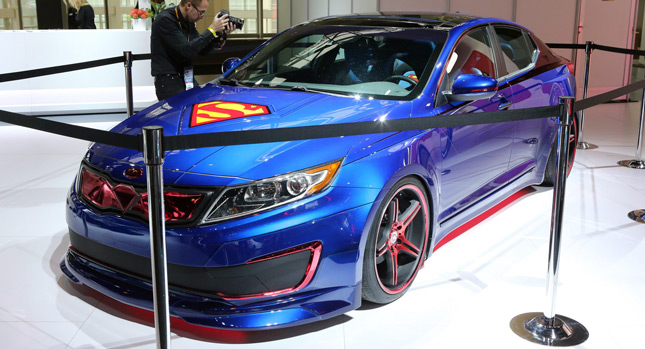
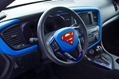
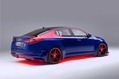
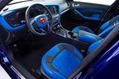
It may be comically slower than a speeding bullet, not even remotely powerful as a locomotive, and it will never, ever be able to leap tall buildings, but the Superman-themed Kia Optima Hybrid that debuted at the Chicago Auto Show will bring to mind the "man of steels" wardrobe with its looks.
Kia teamed up with DC Entertainment and Super Street magazine to create the special Optima Hybrid that belongs to an extended family concepts inspired by the Justice League comic book series, and which up until now, include the Flash Forte Koup, Aquaman Rio 5-door, Cyborg Forte 5-door, Green Lantern Soul and the Batman Optima.
According to the Korean carmaker, these studies help "raise awareness of DC Entertainment’s “We Can Be Heroes” giving campaign, a relief effort to bring help and hope to people affected by drought and famine in the Horn of Africa".
All changes to the Optima Hybrid are cosmetic sans the lowered suspension.








Wednesday, November 13, 2013
Mercedes Benz E300 Blue TEC Hybrid


- Mercedes-Benz E300 Blue TEC Hybrid, 2013
The Mercedes-Benz E300 Blue TEC HYBRID combines the excellent fuel economy of the 4-cylinder diesel engine over long distances (motorway, inter-urban) with the advantages of an efficient hybrid in city and stop & go traffic. It therefore exhibits impressive efficiency with no compromises: thanks to the compact hybrid concept there are no restrictions in terms of spaciousness, comfort and safety.
In the Mercedes-Benz E300 Blue TEC HYBRID, Mercedes-Benz has combined the 2.2-litre four-cylinder diesel engine developing 150 kW (204 hp) with a powerful hybrid module. Its 20 kW electric motor, positioned between the internal combustion engine and the 7-speed automatic transmission, assists the diesel engine when the car is accelerating (boost effect) and, in alternator mode, is used for the recuperation of braking energy, although it is also suitable for driving under electric power alone. Based on the modular hybrid principle developed by Mercedes-Benz, this diesel hybrid is starting a new era in hybrid drive systems. The fuel consumption of the E300 Blue TEC HYBRID is 4.2 litres per 100 kilometres (CO2: 109 g/km).
In combination with 7G-TRONIC, a wet start-up clutch and the lithium-ion battery, the intelligent modular hybrid system requires little installation space and weighs around 100 kg. As in all Mercedes-Benz hybrid models, the hybrid components have all the features of the extensive "7-stage safety concept".
In time for the market launch the Mercedes-Benz E300 Blue TEC HYBRID receive an environmental certificate according to ISO standard TR 14062. The certification by the neutral examiners at "TÜV Süd" attests to the brands commitment to comprehensive environmental protection, which is enshrined in the operating guidelines for the entire Daimler group. In this process the company takes the environmental effects of a vehicle into account throughout its lifecycle - from development and production to use and eventual disposal.
In Germany the Saloon version of the Mercedes-Benz E300 Blue TEC HYBRID costs € 51,794.75, the Estate version € 55,007.75 (both incl. 19% VAT).
The philosophy: enhanced efficiency without compromising on comfort or utility
The Mercedes-Benz E300 Blue TEC HYBRID forms part of the brands downsizing strategy, which involves making conventional models perform far more efficiently than previously - without sacrificing driveability or comfort. Here the companys engineers have their sights set on fuel consumption figures in everyday traffic, rather than on standard or NEDC combined consumption. The familiar "Real Life Safety" philosophy, which focuses on safety benefits under real-life conditions rather than standardised crash-test results, is augmented by "Real Life Efficiency".
The Mercedes-Benz E300 Blue TEC HYBRID is based on the E250 CDI, yet has a higher output and approx. 15 percent lower fuel consumption.
On the road therefore, the Mercedes-Benz E300 Blue TEC HYBRID is comparable to the E300 CDI (170 kW/540 Nm), yet it boasts around 35 percent lower fuel consumption and CO2 emissions. In terms of vehicle weight too, the Mercedes-Benz E300 Blue TEC HYBRID is on a par with the E300 CDI.
At the same time, hybridisation enhances ride comfort: the car starts and moves off in virtual silence, while the hybrid module also dampens any internal combustion engine vibrations. Whats more, full climate control is available even in start/stop mode.
Sailing along the motorway
Mercedes-Benz hybrid technology offers a wealth of extra functions that enhance both comfort and efficiency, as well as helping to deliver a special driving experience underpinned by accomplished sportiness:
- When the car is stationary - ECO start/stop: the internal combustion engine can be switched off when coasting on the overrun at speeds up to 160 km/h, since ancillaries such as the steering, brakes and refrigerant compressor operate electrically. It is restarted quickly, smoothly and virtually silently.
- Manoeuvring: in most cases the car uses electric power alone for manoeuvring and parking.
- Accelerating: electrical power alone is used for moving off and driving under low load. Acceleration from standstill is particularly powerful, since the electric motors full torque of up to 250 Nm is immediately available.
- Boost function: the electric motor supports the combustion engine during acceleration, e.g. when overtaking.
- Cruising: when the car is being driven at a constant speed, the engine control unit shifts the operating points towards exceptionally low specific fuel consumption levels.
- Sailing: "sailing", as it has come to be known, is possible at speeds below 160 km/h. The combustion engine shuts down and the desired speed is maintained by the electric-motor alone until the battery needs recharging.
- Kinetic energy recuperation when coasting or braking: when the car is coasting (decelerating on the overrun), the electric motor acts as a generator. When the brake pedal is depressed, the generator output is initially increased proportionally for greater deceleration. Only when increased brake pressure is applied are the wheel brakes also operated.
- Information: an additional economy effect arises after a relatively short period of time, as drivers come to apply the above-stated functions in an increasingly more purposeful and effective manner. They are supported here by the display concept in the hybrid models - the central display provides information on the current energy flow and the charge status of the battery.
The hybrid module: a compact and intelligently integrated powerhouse
The hybrid drive unit is a further development of the module from the S400 HYBRID and is based on the 7G-TRONIC PLUS automatic transmission. Distinguishing features include omission of the hydraulic torque converter and the addition of a wet clutch of the kind also found in the high-performance AMG models. Consequently, the electric motor can be integrated in the transmission unit in such a way that it takes up only marginally more space than the 7G-TRONIC (+65 mm). The omission of the converter allows all-electric motoring as well as "sailing", thus significantly boosting the potential to reduce fuel consumption.
The compact electric motor, which is installed in space-saving configuration in the clutch housing between engine and transmission, is a 3-phase AC internal rotor magneto motor which generates a maximum output of 20 kW and peak torque of 250 Nm at an operating voltage of 120 volts.
The components: perfectly integrated into the vehicle
The hybrid drives electrical energy is provided by the high-voltage lithium-ion battery specially developed for use in vehicles. Its key characteristics include an output of 19 kW and an energy content of 0.8 kWh, allowing the E-Class to run on electric power alone at up to 35 km/h and for up to one kilometre. Its space-saving installation in the engine compartment in place of the conventional starter battery means that the generous interior dimensions and the luggage compartment capacity remain unchanged. In addition to serving as an energy accumulator for the electric motor, the lithium-ion battery is also connected via the voltage converter to the 12V on-board electrical system, which supplies power to standard power-consuming devices such as the headlamps and the comfort features.
Sophisticated packaging means that numerous hybrid-specific components such as the high-performance electronics in the engine compartment can be directly incorporated with the internal combustion engine, thus neatly rounding off the modularity concept: the hybrid models can be produced on the same assembly line as their conventional counterparts without needing to be diverted elsewhere. Another plus point of the overall concept is the scalability and compatibility with other vehicles and engines.
Safety: on a par with previous models
Integration of the hybrid systems without any body modifications has the practical benefit of not restricting spaciousness in any way, as well as ensuring that all hybrid models boast exactly the same high level of safety as their counterparts with an internal combustion engine - a very important aspect for Mercedes-Benz. Accident behaviour has been successfully tested in crash simulations and tests.
Tuesday, November 12, 2013
Nissan reveals new 2 5L Supercharged Hybrid Engine


In Japan today Nissan released new details about a replacement for their 3.5L V6 currently found in upper trim Nissan Altimas. Instead of going the path many automakers have taken of updating the current engine with Gasoline Direct Injection, Variable Cam timing, or adding a turbo Nissan has created a completely new engine.
This engine now has 4 cylinders, a displacement of 2.5L, a small electric motor and compact lithium-ion battery pack, AND a twin screw supercharger. Nissan engineers are claiming that this will allow the engine to produce power comparable to the 3.5L 260 horsepower and 250 pound-feet engine.
Nissan engineers are also making the claim that the power and torque curves of this engine have been made to mimic that of the larger V6 it is replacing.
Power will be transfered to the rear wheels with Nissans latest generation CVT transmission that has not debuted yet. All of this combined Nissan engineers say to expect similar performance to the V6 while achieving "10-percent better fuel economy."
My Take:
This new engine seems to be another waste of hybrid technology. Customers who opt for a V6 in a family sedan are typically not looking for efficiency but because they want a powerful sedan. This is why I believe that the supercharger makes perfect sense for the Altima. An increase in 10-percent is very marginal when you consider the current 3.5L has an EPA rating of 20 city/27 highway miles per gallon. I think Nissan missed the point for this segment. In one fell swoop Nissan has alienated V6 customers and hybrid customers simultaneously.
[Source: Auto Blog]
Sunday, November 10, 2013
Volvo V60 plug in hybrid

In recent years, the number of car models with hybrid drive is much higher, and the first plug-in hybrid models are already available. A special innovation but Volvo is now launching on the market that combines 2013 Volvo V60 plug-in hybrid that is a diesel engine with a rechargeable electric motor at each outlet.
The combination will create an even more efficient and also provide for the performance of other hybrid models in the shade. It serves as the basis of the Volvo V60 D5, whose 2.4-liter 5-cylinder diesel engine with an output of 215 hp and the plug-in model is giving good service.
In addition, a 70 HP joins (50 kW) electric motor by a 11.2 kWh lithium-ion battery big draws its energy. Volvo Volvo would not, they would not have paid attention to in the development of the security.

The batteries are positioned on the rear axle and thus have a very safe place in case of accidents, even with a strong rear-end collision to the dangerous cargo happen. In addition, Volvo has also developed an optimal cooling for the batteries so that their life is extended.
At first sight you can see the V60 plug-in hybrid to the patch with the message, and the gas cap in the front fender, behind which is the plug for recharging. With a 10A socket fully charge the batteries takes place in 4.5 hours, who has a higher security can complete the loading process even faster.

The interior of the Volvo is finely equipped (it is only in the upscale trim line "Summum" offered) equal to recognize the newly designed digital speedometer, the first time celebrated its premiere in the V40. Besides the large speedometer, the bar graphs are for the flow of energy and the charge state of the battery.
In the center console, behind the selection lever of the 6-speed automatic, three buttons for selecting the desired drive mode are housed. The driver can choose between "Pure", "hybrid" and "Power". In addition, the instrument panel is another key for the mode wheel (EL AWD) is available.
Namely, while the diesel engine outputs the power to the front axle, the electric motor drives the rear wheels, whereby the economical combination also has all-wheel drive.

In Pure mode, you can create up to 50 kilometers solely on electricity and also silently back. At startup, the system is automatically in hybrid mode, which will meet on the diesel engine added. If you drive on gently, working only the electric motor, as long as the batteries are charged.
Only after a courageous step on the accelerator turns then add the diesel engine. Both engines work together then turn the power mode and the economical combination for Sport Wagon. With the power of the V60 diesel engine and electric motor to sprint in just 6.1 seconds from 0 to 100 km / h
The extra weight of the batteries you can feel it at all, the V60 accelerates confident and very quietly up to the desired speed. During driving takes you hardly notice when the diesel engine switches added.
Due to the low center of gravity, which is achieved by the heavy batteries, over the 2-ton Volvo V60 Plug-in Hybrid is fuller on the road and has excellent handling.

The only drawback to the plug-in hybrid is the shrunk to 304 liters of cargo space. Nevertheless, one can achieve by folding down the rear seats, a volume of 1,120 liters, which one can reconcile Customers also place value on the transport properties.
Very positive one then matches the consumption. Thanks to the high range in purely electric mode to get a consumption of only 1.8 liters of diesel per 100 kilometers, while CO2 emissions are thus at only 48 g / km.
By recuperation during braking to charge the batteries again and again while driving, and you really travel a lot with a lot of purely electric or electrical support. With a range of 900 kilometers, you will also create long distances without refueling.

The first impression of the Volvo V60 plug-in hybrid could fully convince. The combination of powerful engine and all-electric drive offers the perfect solution for every occasion and shows that even with high efficiency must not forego driving pleasure.
Production will begin in May 2013, the first copies are then delivered in September 2013. The first edition of 1,000 pieces is sold out.


Friday, October 25, 2013
Ford Fusion Hybrid


- Ford Fusion Hybrid, 2013
The All-new Ford Fusion brings alive the next generation of more expressive vehicles from Ford and is the first sedan to offer gasoline, hybrid and plug-in hybrid versions - each expected to deliver top fuel economy and an engaging driving experience.
Featuring a sleek silhouette and fresh face, the all-new Fusion is the latest in a series of vehicles from Ford - following the 2011 Fiesta subcompact and 2012 Focus small cars - developed to satisfy customers everywhere who want leading fuel efficiency, helpful technologies and game-changing looks.
Ford Fusion is revealed in North America in S, SE and range-topping Titanium series and points to the next Ford Mondeo for world markets.
Triple-crown fuel efficiency
The new Fusion is expected to deliver best-in-class fuel economy across customers choice of gasoline, hybrid and plug-in hybrid sub-segments, following through with the commitment by Ford to be the fuel-efficiency leader - or among the leaders - with each new model brought to market.
Ford Fusion brings the broadest selection of fuel-efficient powertrains in the midsize car segment. It offers hybrid and plug-in hybrid alternatives, a pair of EcoBoost™ four-cylinder engines, a normally aspirated four-cylinder engine, an automatic start stop system to shut off the engine at stationary idle, front-wheel drive and all-wheel drive applications, and a choice between automatic and manually shifted six-speed transmissions.
The 1.6-liter EcoBoost is expected to deliver best-in-class four-cylinder non-hybrid fuel efficiency of 26 mpg in the city and 37 mpg on the highway. The 2.0-liter EcoBoost engine - paired with a paddle-shifted six-speed SelectShift Automatic™ transmission, available 19-inch wheels and tires, and all-wheel drive with the ability to send additional torque to the rear - is the Fusion performance option.
The Fusion Hybrid - 2010 North American Car of the Year - continues to innovate and evolve with all-new lithium-ion batteries that save weight and generate more power than previous nickel-metal hydride batteries, while raising maximum speed under electric-only power from 47 mph to 62 mph.
Ford Fusion Hybrid also features an all-new 2.0-liter Atkinson-cycle four-cylinder gasoline engine, significantly downsized from the previous 2.5-liter unit while maintaining performance standards. This innovative powertrain is anticipated to deliver best-in-class fuel economy of 47 mpg in city driving and 44 mpg on the highway.
Ford Fusion Hybrid fuel economy stands to outperform the 2012 Toyota Camry Hybrid by 4 mpg city and 5 mpg highway and the 2011 Hyundai Sonata Hybrid by 12 mpg and 4 mpg, respectively.
Topping the fuel-efficiency ladder is the Fusion Energi plug-in hybrid, aiming to be the most fuel-efficient midsize car in the world. Arriving this fall, Fusion Energi is anticipated to deliver more than 100 MPGe, a mile per gallon equivalency metric for electrified vehicles. This is 8 MPGe more than the Chevrolet Volt and 13 MPGe more than the projected efficiency of the Toyota Prius plug-in hybrid model.
The next-generation Fusion 1.6-liter is the first automatic-transmission Ford product offered with an automatic start stop system. It shuts off engine power smoothly when the car is stopped and seamlessly restarts as the driver releases the brake pedal, helping Fusion to reduce fuel consumption and emissions by approximately 3.5 percent.
Ford Fusion looks out for you
The all-new Fusion offers an unprecedented portfolio of driver assistance and convenience technologies based on sensors, cameras and radar that enable the car to see and respond.
Ford Fusion can help drivers maintain proper lane position, adjust vehicle speed to changing traffic conditions, identify suitable parking spaces and help park, even aiding drivers backing out of parking space where visibility is obstructed. Specific technologies:
- Lane Keeping System: This class-exclusive technology consists of three elements to help a driver maintain proper lane position. Using a small, forward-facing camera behind the inside rearview mirror, the system "looks" down the road, monitoring lane lines to determine that the car is on course. The system will alert a driver if drowsiness or erratic lane-keeping is detected. The second element warns a driver with a steering wheel vibration if the Fusion drifts too close to lane markings. Finally, lane keeping aid will actually apply pressure on the steering to help bring the car back into proper lane position
- Adaptive cruise control: Using forward-looking radar, this system "looks" down the road when activated, slowing the Fusion when slower traffic is detected ahead. Adaptive cruise control enables collision warning with brake support to help slow the car if the potential of a crash is detected
- Active park assist: Employing sensors, this technology can identify a suitable parallel parking space, calculate the trajectory and steer the car to properly position it within the spot. All a driver need do is operate accelerator and brake pedals
- Blind Spot Information System (BLIS) with cross-traffic alert: Sensors in both Fusion rear quarter-panels are able to detect traffic in a drivers blind spot, providing both audible and visual warnings if traffic - unseen by the driver - is detected. BLIS technology enables cross-traffic alert, warning the driver of oncoming traffic when backing out of a parking space with obstructed views, such as between two large vans
The power of voice
The all-new Fusion offers the latest iteration of Fords award-winning, industry-exclusive SYNC communications and entertainment system, which enables voice-activated communication through a drivers mobile phone and interaction with the cars audio system.
Fusion also offers the latest version of MyFord Touch®, allowing a driver to interact with vehicle systems through voice control, a touch screen tap or a conventional button.
Both SYNC and MyFord Touch - powered by SYNC - help reduce the potential for driver distraction through voice-controlled functionality, allowing drivers to keep hands on the wheel and eyes on the road.
Different, by design
These five elements provided direction for the design team behind the all-new Ford Fusion:
- Silhouette innovation: Fusions sleek profile sets it apart from the powertrain/cabin/trunk "three-box" designs synonymous with midsize sedans
- Perceived efficiency: Fusion character lines sweeping to the rear and thin roof pillars suggest the car is nimble and light on its feet
- Refined surface language: Fusion demonstrates that a tasteful, well-executed design does not require add-ons or visual clutter
- Technical graphics: Fusions functional design elements such as headlamps, LED taillamps and polished exhaust tips communicate enhanced technological capability
- New face: Fusion signals the next evolution in Ford global design language for midsize cars and smaller
Inside, the new Fusion offers a sporty, driver-oriented environment with next-generation seating that brings expanded functionality. A higher center console supports the driver-centric theme and yields clever storage for items a driver wants to keep handy.
Additional passenger space was designed-in by moving the instrument panel toward the windshield, contributing to the cabins airy, open environment. Thinner, lighter frames support the comfortable next-generation seats trimmed with fabric using recycled sustainable yarns.
Craftsmanship plus dynamics equals feel
Ford Fusion design delivers on the promise of high visual quality, with improved materials, elevated levels of craftsmanship and attention to detail.
Interior surfaces are softer to the touch and interior and exterior gaps are minimized, while extra care has been taken to upholster or cover each edge and every surface a customer can touch. When the trunk lid is opened, for example, a spring-loaded cover automatically conceals the trunk latch hardware.
Key contributors to how the Fusion feelsare the ride and handling components that maximize vehicle dynamics.
Careful tuning by Fords vehicle handling and ride team has yielded a Fusion with a dynamic character that will please a well-seasoned enthusiast while increasing the confidence level of less-experienced drivers.
Ford Fusion interior quiet reaches a new level with acoustic underbody shields and weight-saving sound-absorption material; both minimize road and powertrain noise while boosting aerodynamic efficiency to help save fuel. The all-new model adds content such as a full-perimeter hood seal to be among the midsize sedan segment leaders in giving drivers a quiet ride.
Fusion Hybrid and Fusion Energi models also are equipped with active noise control. This feature uses the audio system to mitigate extraneous road noise while enhancing powertrain sounds.
Strength and safety
Fusion is designed with customer safety in mind. Engineers increased its body strength by 10 percent, using more high-strength steels such as boron, and added dual first-row knee airbags and adaptive front airbags that vent and tether to conform to a specific occupants size, position and seatbelt usage.
The Fusion safety team targeted top-of-the-line ratings in each public domain safety benchmark, including National Highway Traffic Safety Administration ratings, the Insurance Institute for Highway Safety Top Safety Pick and top ratings in world markets where the car will be sold.
The most prominent example is Ford Fusions front-end architecture, as the same car must face simultaneous - and seemingly conflictive - standards across regions. The cars front end is equipped to meet head-on and offset barrier standards for North America while still conforming to European standards for pedestrian protection - thanks to hours of computer modeling and 180 validating crash tests.
Ford Fusion will be produced at Fords Hermosillo, Mexico, manufacturing facility, soon adding production at AutoAlliance International Plant in Flat Rock, Mich. The car will appear in Ford showrooms in North America and South America later in 2012. Mondeo will be introduced in 2013 in Asia and Europe.